Showing posts with label ghosts of Wales. Show all posts

Sunday, 4 July 2010

Spooky Sunday


In the current issue of Paranormal Magazine there is an article by Richard Freeman on particularly weird ghosts. I'm going to have a crack at coming up with a similar selection in the next issue. First port of call for me is the works of the Rev Edmund Jones, known as 'The Old Prophet', who lived in South Wales in Georgian times. He claimed to have seen fairies as well as ghosts and believed that to deny the existence of such supernatural entities was the first step towards disbelieving in God.

In his books An Account of the Parish of Aberystruth (1779) and the following year's Apparitions of Spirits in the County of Monmouth &c, as well as a later unpublished manuscript residing in the National Library of Wales, Jones recounts a number of stories by his congregation and neighbours of encounters with a number of, frequently very bizarre, spooks. They make up the strangest body of ghost stories from Wales and yet are among the best attested, in that Jones is able to give precise information regarding locations, dates and biographical details of the experiencers, who were all known to him (and, of course, whose truthfulness was always above question!).

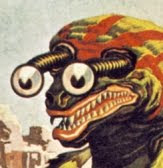
Among the spooks described are apparitions of bestial beings crawling on all fours, or on their hands or turning over and over 'topsy-turvy' fashion; incredibly tall or massive figures; half-formed silhouettes of people; shapeless things and floating black 'bowls' (balls). Perhaps the strangest - and the one I will be using in my article - is the follwing account from a farm in in the parish of Trevethin, near Pontypool. I quote from my Haunted Wales (2005). Watch out at a later date for the illustration, which will be by my friend Jonathan Edwards.

[A milkmaid] saw it loitering by a holly tree one evening as she went to milk the cows. It was approximately the shape of a man but ‘very big in the middle and narrow at both ends’ and when the girl’s dog approached it, it shot out a long, black tongue, scaring it away. With a heavy, earth-shaking tread, the monster marched off in the direction of a well suspiciously named Ffynnon yr Yspryd (Well of the Ghost), where it disappeared.

Sunday, 27 June 2010

Spooky Sunday


I'm looking at having Haunted Wales republished in two volumes by The History Press now that Landmark have gone bust. With Haunted Wales I set out to find all the old - that is pre-War - stories recorded in written primary sources from Wales. I was surprised to find a yarn from Flintshire that I had missed when researching Haunted Clwyd etc years before. Mind you, it was in the form of a piece of inexorable doggerel verse tucked away inside some old periodical, so perhaps it wasn't so odd that I missed it. It's not much of a story but it has its amusing moments and does shed some ligth on old ghost-lore. Here is the story as recorded in Haunted Wales:
Once upon a time, possibly in the 1740s but details are vague, a ghost was seen in the laundry at Hawarden Castle. A ‘misty form’ resembling that of a deceased steward called John drifted past several maid-servants, driving them into hysterics. John had been an unpopular bully during life, an absolute tyrant to those he considered his inferior, so this may explain their extreme reactions.

Lady Marshall, who learnt of the incident from a 90-year-old servant whose mother had been one of the maids, wrote it up in the form of a whimsical ballad. The ballad is very long but the story very slight, and it took some time to dissect it from Lady Marshall’s intentionally rococo language and shamelessly bad rhymes. We learn the staff were very distressed –

‘And they, for want of public ghost inspector,
Resolved to lay the case before the Rector.’
(You get the idea!)

The rector told them they were all ‘tom-fools’, so instead the servants sought out the services of a sympathetic priest, who agreed to perform the rites of exorcism. The ghost was duly conjured up among the sheets and smalls in the laundry, and John-as-was told the priest that ‘after so much wrong’ performed by him on his fellows, his spirit was unable to find a resting place. He did not explain why, of all places, he chose to haunt the laundry, and on being told ‘he must be laid’, he begged that it be in somewhere more salubrious.

Initially he suggested his spirit be conjured into a crow (which seems somewhat less salubrious to me) but the priest rejected this idea because he thought it might lead to ‘mischief’. So, John then suggested he be turned into a harmless leaf, but the priest also disapproved of this plan. He argued that an unfortunate cow might chance to eat the leaf – and the cow become possessed! Finally, John agreed to be secured inside a block of granite. This was done, the stone buried, and John’s spirit no longer troubled the living.
(The picture shows Hawarden Castle in about 1880, when it was the residence of W E Gladstone).

Sunday, 13 June 2010

Spooky Sunday


Finally got round to visiting Gwydir Castle, near Llanrwst today, albeit in pouring rain. I'm particularly pleased with the interior shots here, partly because they were taken on a quarter-of-a-second exposure (without flash of course) and I think they've come out surprisingly well. But also because it turns out photography (even without flash) was supposedly forbidden inside the house, despite the lack of signs stating this and the failure of the guy who sold us the tickets mentioning it. Neverthless, they're certainly not shy about telling off their paying visitors if, like me, you are heinous enough to do so in blissful ignorance. Pity, because up until that point it was a very enjoyable, atmospheric visit, depsite the rain. Being talked down to by a posh twat does spoil the mood somewhat.

Anyway, on to the ghosts. Gwydir is the ancestral home of the important North Wales family the Wynnes and has a long-established haunted room. The apparition of a young woman has been seen in and around the 'Ghost Room' and she is linked to a horrible, unearthly smell of decay which has also sometimes been detected. Legend has it the ghost is of a servant seduced by one of the past Wynnes who was murdered by him and her body secreted in a chimney breast backing on to the room. A sizeable cavity has been found in this chimney and is now labelled a 'priest hole'.

According to the house's website, www.gwydircastle.co.uk, other ghosts have been reported here, including that of the first Sir John Wynne (said to be so wicked that his spirit is trapped at the bottom of the Swallow Falls in Betws until it is washed and purified), a 'procession' on the Great Terrace and the apparition of a dog, possibly the one whose skeleton was found some years ago in the cellar. The eerie sound of children crying has been heard, too.

Another story regarding Gwydir Castle is eluding me: something about some history project by schoolchildren leading to a strange 'coincidence' but I am unable to find a reference to it. Perhaps it was something I was simply told many years ago back in the days when I'd stopped writing about ghosts and folklore. Perhaps I simply forgot to take a note of it. Bother. If I find a reference or remember it, I'll let you know.

When I asked Janet Bord to compile her top ten favourite haunted houses (that are open to the public) for an article for Paranormal Magazine last year, she voted Gwydir number one, for its atmosphere. When me, James and Rosie first arrived and were alone in the the house - pre-telling off - we could certainly understand why.

Sunday, 2 May 2010

Spooky Sunday


Tonight I'm giving a talk at The Sportsman's Arms, which is out in the middle of nowhere on the Denbigh Moors in North Wales. The nearest building, in fact, is the ruined hunting lodge known as 'The Haunted House' by everyone because it looks like it ought to be (although, in fact, it isn't).


This vast area of moorland and conifer woods known as the Hiraethog is rich in folklore, particularly fairylore, and in the middle of the woods some years ago local resident Judy Young found a tiny wigwam structure among the trees. It was less than a foot high but beautifully constructed of bracken and twigs and had a neat fence round it made of pine needles and woven grass. She managed to get a photo of it (it's reproduced in my Wales of the Unexpected) but was never able to find it again.


Anyway, it's Judy who's organised the talk. The Hiraethog is so vast and empty that I guess the Sportsman's has a wide catchment area. Judy has arranged a series of talks and events (holy wells expert Tristan Gray-Hulse was there recently) to keep business going out of the tourist season. There's no pay, but I'm hoping it'll be quite good fun and some interesting people to meet. It was Janet Bord, a friend of Judy's, who encouraged me to take part, so she will be there and with any luck there will also be people in the audience (assuming there is an audience!) who will have ghostly experiences of their own to relate.


I'm not putting together a formal talk, I'll wing it a bit, chatting about some of the things I've picked up since editing Paranormal Magazine, as well as weaving in some local ghost stories. Which reminds me - I must find out if anyone knows anything about the 'cursed Roman bridge' that's supposed to be in the vicinity of the pub. Allegedly, it's haunted by a Roman soldier, but to see him means certain death - unfortunately, the only source of the story is the late Jane Pugh, who was unreliable to say the least.

Sunday, 4 April 2010

Spooky Sunday


Fans of the works of J R R Tolkien will be familiar with the Barrow-wights, mysterious, malevolent beings that inhabited ancient burial mounds, guarding the treasures interred within.
Tolkien’s Barrow-wights may have been inspired by traditions once prevalent in parts of South West England. Professor Leslie Grinsell collected an astonishing corpus of tales associated with Britain’s ancient monuments and in Dorset he learnt of the ‘Gabbygammies’, beings very similar to Tolkien’s. Referring to a Bronze Age round barrow at Ashmore (now destroyed), Grinsell writes:

‘It was formerly haunted by Gabbygammies or Gappergennies who made strange noises which ceased after the barrow was opened and human bones found in it removed to the churchyard and reburied there.’

In my home county of Flintshire, there is a story about a tumulus at Axton haunted by similar creatures. The barrow, near a house called Ty Gwyn, formerly had a 7-ft high stone standing on its summit. Due to the presence of a hole drilled through its upper part, this bore the name of Carreg-y-doll (the Holed Stone). The stone was given a wide berth in daylight and avoided altogether after dark, for it was believed the barrow on which it stood was the home of evil goblins – bwbachod – who guarded fiercely a valuable treasure hidden there. Their mindless gibbering could often be heard emanating from within.

One evening, according to tradition, a stranger passed by Carreg-y-doll and perceived its silhouette faintly illuminated by a ruddy glow, apparently given out by the stone itself. He decided to investigate, and as he got close he could hear an eerie sound, as of the pained whimpering of some animal coming from beneath it. He stepped up on to the barrow.
Immediately, he was gripped by a powerful force. It felt as if two enormous hands had grabbed him by the shoulders. He was lifted off his feet and thrown against the side of the mound. He struggled wildly, but the invisible force held him fast. His ears were filled with the fearful sound of an insane gibbering and his eyes were blinded by a red light. The earth seemed to open up around him, and he felt himself being dragged beneath, down and down to some black place…
The next morning, the stranger was discovered, wandering around and around near the stone in a delirium. He muttered over and over again something about a terrifying place full of evil-faced goblins and weird cackling, and sights which had obviously petrified him, but which he was never able to fully describe. As he recovered, he seemed to have forgotten his experience and never spoke of it again...
That at least is the story, which comes from a Welsh language book of folklore published in 1938, Coelion Cymru (pp 109-10). The stories in it were collected by Evan Isaac, who lived in Holywell. The stone has long gone and it's hard to work out which of the many tumuli near Axton is the one referred to - but either one of the two photographed here would be a good guess. Northern Flintshire, incidentally, represents one of the most extensive Bronze Age burial grounds in Britain - there are scores of barrows in the Gorsedd/Llanasa region.