
H P Lovecraft's imagination and total commitment to his own mythology have made him arguably the most influential horror writer of the 20th century (along with M R James). Alas, his prose can be patchy: overly baroque, dense and pretentious. But here's an example of him at his best, an evocation of the New England backwaters that inspired so much of his work. It's from one of his more subtle stand-alone short stories, The Picture in the House, written in 1920.
Searchers after horror haunt strange, far places. For them are the catacombs of Ptolemais, and the carven mausolea of the nightmare countries. They climb to the moonlit towers of ruined Rhine castles, and falter down black cobwebbed steps beneath the scattered stones of forgotten cities in Asia. The haunted wood and the desolate mountains are their shrines, and they linger around the sinister monoliths on uninhabited islands.
But the true epicure in the terrible, to whom a new thrill of unutterable ghastliness is the chief end and justification of existence, esteems most of all the ancient, lonely farmhouses of backwoods New England; for there the dark elements of strength, solitude, grotesqueness and ignorance combine to form the perfection of the hideous.
Most horrible of all sights are the little, unpainted wooden houses remote from travelled ways, usually squatted upon some damp, grassy slope or leaning against some gigantic outcropping of rock. Two hundred years or more they have leaned or squatted there, while the vines have crawled and the trees have swelled or spread. They are almost hidden now in lawless luxurience of green and guardian shrouds of shadow; but the small-paned windows still stare shockingly, as if blinking through a lethal stupor which wards off madness by dulling the memory of unutterable things.
In such houses have lived generations of strange people, whose like the world has never seen. Seized with a gloomy and fanatical belief which exiled them from their kind, their ancestors sought the wilderness for freedom. There the scions of a conquering race indeed flourished free from the restrictions of their fellows, but cowered in an appalling slavery to the dismal phantasms of their own minds. Divorced from the enlightenment of civilisation, the strength of these Puritans turned into singular channels; and in their isolation, morbid self-repression, and struggle for life with relentless Nature, there came to them dark, furtive traits from the prehistoric depths of their cold Northern heritage.
By necessity practical and by philosophy stern, these folks were not beautiful in their sins. Erring as all mortals must, they were forced by their rigid code to seek concealment above all else; so that they came to use less and less taste in what they concealed. Only the silent, sleepy, staring houses in the backwoods can tell all that has lain hidden since the early days, and they are not communicative, being loath to shake off the drowsiness which helps them forget. Sometimes one feels that it would be merciful to tear down these houses for they must often dream.


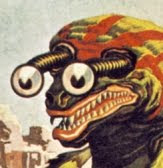
 Many thanks to Ciaran, my friend in Singapore, for tipping me off to a further collection of weirdness for Monstrous Monday: a series of illustrations by Japanese artist Tatsuya Morino of classic horror stories. Shown here in order from the top are: The Fly (wearing slippers!) by Frank Langelaans; The Sea Raiders by H G Wells; Murders in the Rue Morgue by Poe; A Voice in the Night by William Hope-Hodgson (good call!); and The Call of Cthulhu by Lovecraft. You can see the set at:



 Posts

